Backlash by George Yancy
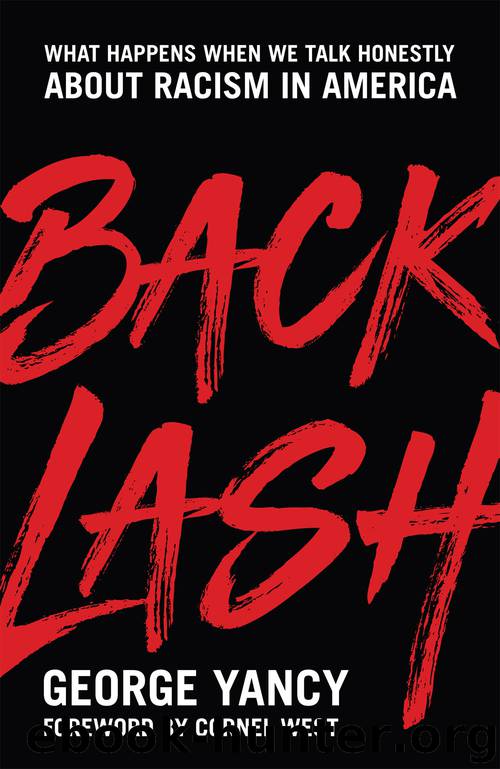
Author:George Yancy
Language: eng
Format: epub
ISBN: 9781538104064
Publisher: Rowman & Littlefield Publishers
Published: 2018-03-02T05:00:00+00:00
Your gift is a pernicious one. Telling me that I am no more than my race doesn’t invite me to grow. Telling me that I am no better than the worst of my kind doesn’t coax me from my herd. I can think of no better way to alienate would-be allies. King invited me to become something better. You tell me I’m something less.
Well, I did say in the letter that some gifts can be heavy to bear. But why was it perceived as pernicious or evil? And, again, I take issue with the assumption underlying what the reader means by “race.” To commit to the claim that one is no more than his/her “race” is to support reductionist assumptions about “race” that are indicative of white racist thinking throughout the history of Europe and America. For example, as Black, as being a member of a certain racial group (call it “Negroid”), I’m deemed “inferior”; I am no more than my race. And I would assure the white reader, and any white reader reading this book, that Black people are painfully aware of how such assumptions don’t “invite” us to grow. More painfully, Black people were not only not “invited” to grow, but we were oppressed, taught that we were “stupid,” “ugly,” and meant to be “slaves for life,” in order to destroy any aspiration to grow. And to keep us in “our place” (assuring us that we were no more than our race), we were brutally beaten and killed as a consequence of trying to be more than white people stipulated. Surely, this is not what I’m doing in Dear White America. In fact, there was an invitation to grow. To encourage white people to understand how they benefit from structures of white racist power that are historically grounded, pervasive, subtle, and often invisible to them, is actually an encouragement to enlarge their consciousness and to see the world with greater clarity, especially in terms of its complexity. That is not pernicious.
The white reader’s discourse of “my kind,” which I don’t use, is again reductionist. There is no “my kind.” However, there are people who we recognize as “white” and who thereby have a different relationship to a country that is predicated upon white supremacy. I am concerned with the discursive and structural forces that made it possible for some people to “become white,” and thereby come to occupy supposedly the “apex” of humanity and civilization, not with “my kind” or “your kind.” That is too fixed. The white reader also implies that I hold that he/she is no better than “the worst of my kind.” I assume that the reader is saying that I hold that he/she as white is no better than, say, the KKK. In Dear White America, I never made such a claim. What is evident to me is the white reader’s desire that there should be a clear distinction between “good white people” and the “bad ones” (the KKK). There is also a sense
Download
This site does not store any files on its server. We only index and link to content provided by other sites. Please contact the content providers to delete copyright contents if any and email us, we'll remove relevant links or contents immediately.
| Anthropology | Archaeology |
| Philosophy | Politics & Government |
| Social Sciences | Sociology |
| Women's Studies |
Nudge - Improving Decisions about Health, Wealth, and Happiness by Thaler Sunstein(7706)
The Fire Next Time by James Baldwin(5444)
iGen by Jean M. Twenge(5415)
Adulting by Kelly Williams Brown(4574)
The Sports Rules Book by Human Kinetics(4386)
The Hacking of the American Mind by Robert H. Lustig(4383)
The Ethical Slut by Janet W. Hardy(4251)
Captivate by Vanessa Van Edwards(3839)
Mummy Knew by Lisa James(3691)
In a Sunburned Country by Bill Bryson(3542)
The Worm at the Core by Sheldon Solomon(3487)
Ants Among Elephants by Sujatha Gidla(3467)
The 48 laws of power by Robert Greene & Joost Elffers(3291)
Suicide: A Study in Sociology by Emile Durkheim(3022)
The Slow Fix: Solve Problems, Work Smarter, and Live Better In a World Addicted to Speed by Carl Honore(3009)
The Tipping Point by Malcolm Gladwell(2921)
Humans of New York by Brandon Stanton(2873)
Get What's Yours for Medicare: Maximize Your Coverage, Minimize Your Costs by Philip Moeller(2730)
Handbook of Forensic Sociology and Psychology by Stephen J. Morewitz & Mark L. Goldstein(2705)
